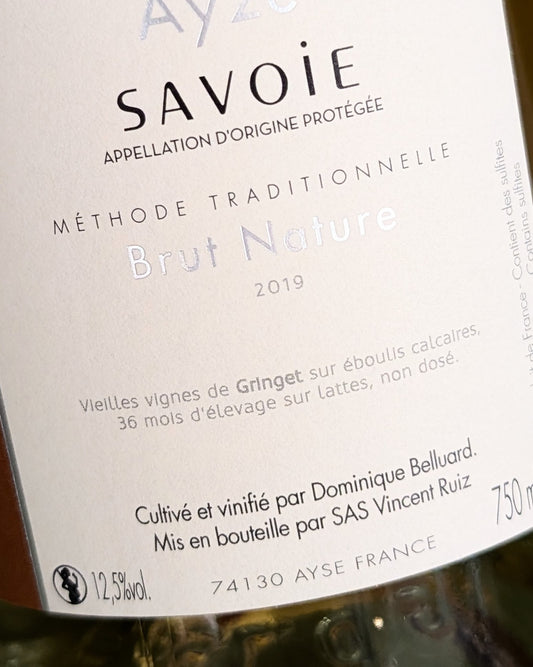
For a long time, Gringet remained a secret of the Arve Valley. A few hectares clinging to the slopes of Ayse, at the foot of Mont Môle, between the cold winds descending from Mont Blanc and the scree left by the glaciers. A grape variety that many considered a local curiosity, destined to produce a few Savoyard bubbles, without imagining what it could offer when a lifetime was dedicated to it.
Dominique Belluard gave that lifetime to Gringet.
From the late 1980s, he undertook an almost obstinate effort. Observing each plot. Understanding the nuances of glacial moraines, limestones, and red clays. Reducing yields. Converting the estate to biodynamics long before it became common practice. Above all, forgetting recipes to let the vineyard guide every decision.
Little by little, the wines changed dimension. They never sought effect. They advanced with restraint, like the alpine landscapes from which they originated. A delicate texture, a silent energy, subtle bitterness, a salinity that settles in without ever hardening the wine. More than a demonstration of power, they give the impression of breathing mountain air.
Perhaps the most fascinating aspect is that Belluard never tried to make Gringet resemble another great grape variety. Not Chardonnay, not Savagnin, not Chenin. He let it speak in its own language. Ampelographic studies would later confirm what his wines were already saying: Gringet is a unique grape variety, deeply rooted in this valley, of which it seems to be a natural extension.
When Dominique Belluard passed away in 2021, Savoie lost one of its greatest artisans. But his work extends far beyond his estate. He brought Gringet a recognition it had never known and reminded us that a great wine sometimes arises from a single conviction: believing in a place that everyone had eventually forgotten.
At French Theory, Belluard holds a special place. Because his bottles tell much more than a terroir. They speak of patience, doubt, intuition. They prove that an immense wine can be born from a grape variety whose name hardly anyone pronounced thirty years ago.