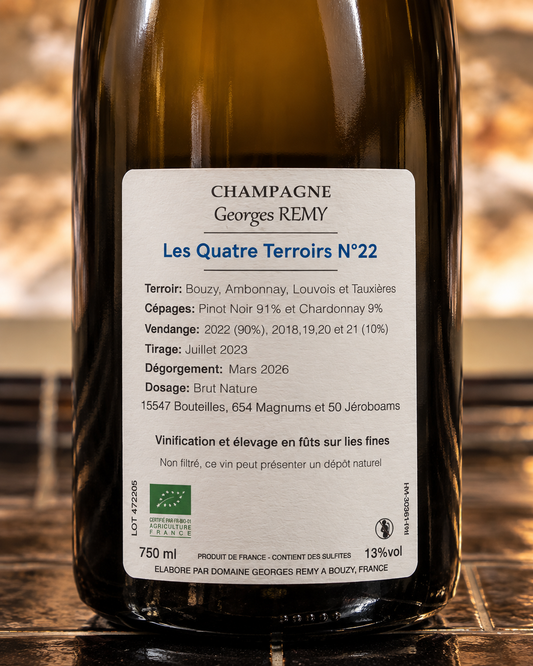
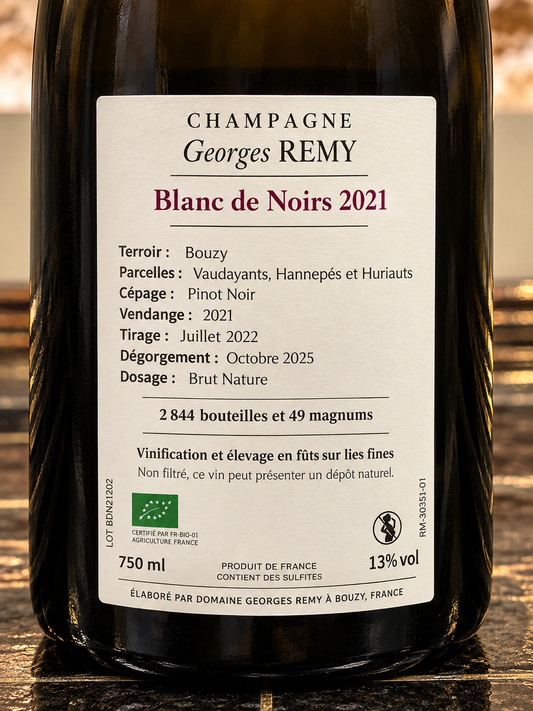
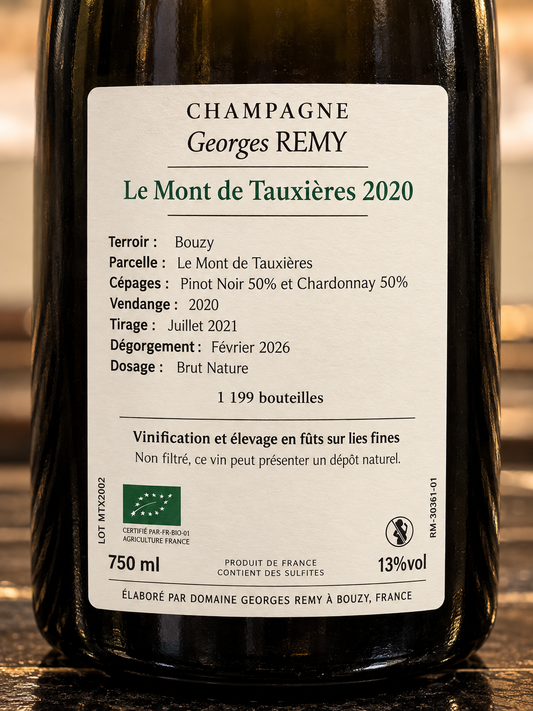
In 2014, when Georges Remy made his first Champagnes, he did not yet know which parcels would eventually become individual cuvées.
So he chose to press them separately. Among the parcels that caught his attention, he kept one barrel from each to taste, compare and understand what each site could express. Part of the range began to take shape this way, from that very first vintage.
“That’s when we identified the sites.”
This way of beginning says a great deal about Georges Remy. Before claiming a terroir, he prefers to taste it.
Returning to Bouzy
Georges returned to the family estate in 2000. At the time, his parents sold their grapes to négociants. He worked the vineyards alongside his father, while developing a vineyard-services business and beginning to make red wine for himself.
Wine, then, came before Champagne.
The first Coteaux Champenois followed in 2011. It was only in 2014, once his parents had retired, that Georges began producing his own Champagnes.
That chronology is significant in Bouzy. Pinot Noir accounts for the vast majority of the village’s vineyards, and Georges first approached it as a grape destined to make wine, with all that this implies in terms of ripeness, substance and structure.
“It would be a shame to have Pinot Noir and end up with a thin wine.”
Yet power is not what he is looking for. In the vineyard, Georges tastes the grapes and waits for the moment when vegetal notes give way to fruit. Depending on the year, that shift does not occur at the same potential alcohol level. The decision is therefore not about reaching a number, but about tasting.
Letting the vines evolve
Herbicides were completely abandoned in 2012. The estate began its organic certification process in 2015, with the first certified harvest coming in 2018.
Georges works with massal selections, preserves his old vines and favours replacing individual missing vines rather than systematically replanting entire parcels. He also thinks carefully about pruning and the way each vine occupies its space, going so far as to work with Italian master pruners.
He experiments with certain biodynamic preparations without turning his practices into doctrine, remaining very clear about what he observes and what he does not claim to be able to explain.
In Bouzy, conditions can change quickly: soil depth, proportion of clay, chalk, slope, exposure and proximity to the forest. Hauts Clos, at the very top of the hillside, lies in a hollow beside the forest: the sun reaches it late and leaves early, and the parcel is consistently among the last to be harvested.
Separate vinifications allow Georges to follow these differences—not a theoretical idea of each site, but what it actually gives in the glass.
Oak, lees and time
In the cellar, the wines are fermented and aged in wood. Georges works with several coopers so that no single signature dominates.
He does not use oak for its flavour. What interests him is what it brings to the ageing process: the wine’s relationship with its lees, its substance, texture and length.
“When you have beautiful grapes, you have beautiful lees.”
The wines therefore remain on their lees until the end of élevage. Small vessels play an important role, while larger barrels and foudres are used notably for part of the reserve wines.
Dosage follows the same logic.
“For me, if you don’t need to add dosage, it means you found the balance in the grapes.”
Some single-parcel cuvées are then bottled under cork for their second fermentation and given longer ageing. Georges could support the estate’s growth by releasing his wines younger; instead, he prefers to give them time.
A common thread, then the individual sites
When we tasted the range in Bouzy, one thing carried through from one wine to the next: a common thread, without uniformity.
Substance without heaviness, energy, a saline quality, and fine bitters that extend the finish. There is restraint, too: these are not wines that necessarily seek to reveal everything immediately.
And yet the individual sites remain clearly perceptible. The texture changes, as do the aromas. Some cuvées are immediately accessible; others still seem compressed, asking for time.
Ultimately, this is what Georges began looking for in 2014 when he kept those first barrels separate: to understand what distinguishes one site from another.
More than ten years later, the range has taken shape. The differences remain.