There are few places where you get the feeling that a vineyard is still inventing itself.
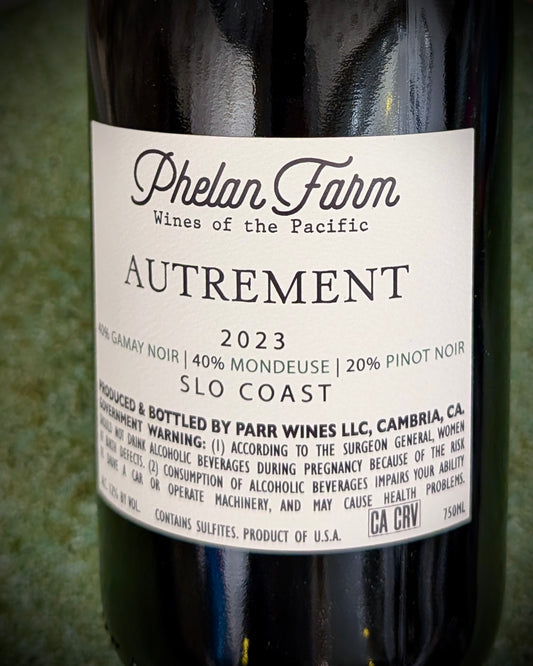
Phelan Farm is one of them.
In Cambria, on California's Central Coast, between the Pacific Ocean and the Santa Lucia hills, Rajat Parr found a place capable of challenging many preconceived notions about Californian wines. Here, ocean fog, constant winds, and cool temperatures shape a uniquely singular climate, far from the powerful images often associated with the region.
Rajat Parr first established himself as one of the most influential sommeliers of his generation. His book, The Sommelier's Atlas of Taste, is now a worldwide reference. His perspective has always been nourished by great European vineyards. His admiration for the Jura and Savoie regions led him to plant mass selections of Savagnin, Poulsard, Trousseau, Jacquère, and Gringet, alongside Mediterranean and Rhône varietals already present on the estate.
But Phelan Farm is not trying to replicate a European vineyard.
The estate is gradually building a unique viticultural landscape, where each grape variety naturally finds its place in an ecosystem designed as a whole.
Agriculture here is regenerative. Vines coexist with fruit trees, animals, market gardens, and omnipresent biodiversity. No herbicides, no pesticides, no copper. Fermentations are spontaneous, and the wines receive no enological inputs or added sulfur.
Each cuvée thus expresses a place more than a method.
The wines possess a singular energy. The textures remain ethereal despite the Californian sun, carried by persistent salinity, natural balance, and a freshness that seems to come directly from the Pacific. An expression of the climate as much as the soil, where finesse always triumphs over demonstration.
Phelan Farm is not an estate that resembles the Jura.
It is a profoundly Californian estate that dialogues with the greatest terroirs in the world to invent its own language. Here, California no longer looks to Europe as a model, but as a conversation.